On moving, again
I’d rather write an article about leaving than unpack my bags only to pack them up again.

The first time I felt terribly homesick in Chennai was during my friend Becca’s 21st birthday. I remember feeling sick to my stomach. Her birthday was an event we had all looked forward to always. The food, the booze, the conversations, and Becca’s iconic hosting skills.
But I could never really say it out loud that I was homesick.
I could not tell my mother that the only time I missed home that terribly was because of Becca’s birthday. It would upset her. And I never really told my friends either, because I did not know how to explain it without sounding envious of their ability to party late into the night and exist within a kind of familiarity I did not have anymore.
So I did what I do best: I told my roommate I was feeling sad, doomscrolled for hours, slept it off, and pretended to never think about it again.
That was in November last year, and now I am finally back home.
It has been exactly two weeks in Bangalore after eight months in Chennai. I have a degree, and I secured a job, and on the surface that is probably the definition of a successful 21-year-old.
But deep down, these two wins feel so small in comparison to the losses I have carried over the past year.
I was over at Becca’s apartment recently. Our friend Jessica was there too. It was my first time stepping out properly after moving back. The commute was painstakingly long, but for the first time, I did not complain. The traffic did not bother me as much, standing in the metro felt alright, and walking through a neighbourhood that was home made me smile — almost enough to frolic down its decrepit streets.
But sitting in Becca’s apartment and having a conversation with two of my closest friends, I realised that in three weeks, I would not have all of this, again.
The last time, it did not hit me because I wanted to leave desperately. But this time, I felt sad.
For once, I wanted to stay, and I had reasons to.
In the span of a year, I will have moved across two cities. When I say it out loud, it probably sounds extremely mundane to most people. I am sure there are people who have moved far more than this.
I was raised in Bangalore all my life, and for most of it, I never saw myself moving anywhere else. But when the thought of leaving finally occurred to me, it was so desperate that there was no turning back. I did not hate the place or the people. If anything, wanting to leave came from a rebellious urge to step out of the insulated bubble I had grown up in.
I never really thought I would succeed at it, but when the acceptance letter from college came in that April, it was suddenly happening. It was finally time for me to move.
I had everything pictured in my head. The number of suitcases, the clothes I would pack, the last sleep in my bed, the final dinners, the emotional goodbyes. And in retrospect, all of it feels so dramatic now.
The last dinner was insignificant, and the goodbyes were barely teary-eyed. Maybe I was expecting too much, after all, I was only moving to a city six hours away (four and a half by a superfast train).
On my way to the station last June, I really wanted to romanticise leaving the city, but I was too busy quarrelling with my mother. And by the time the train pulled out of the station, I was already asleep. I never really got to say Bengaluru the goodbye I had imagined.
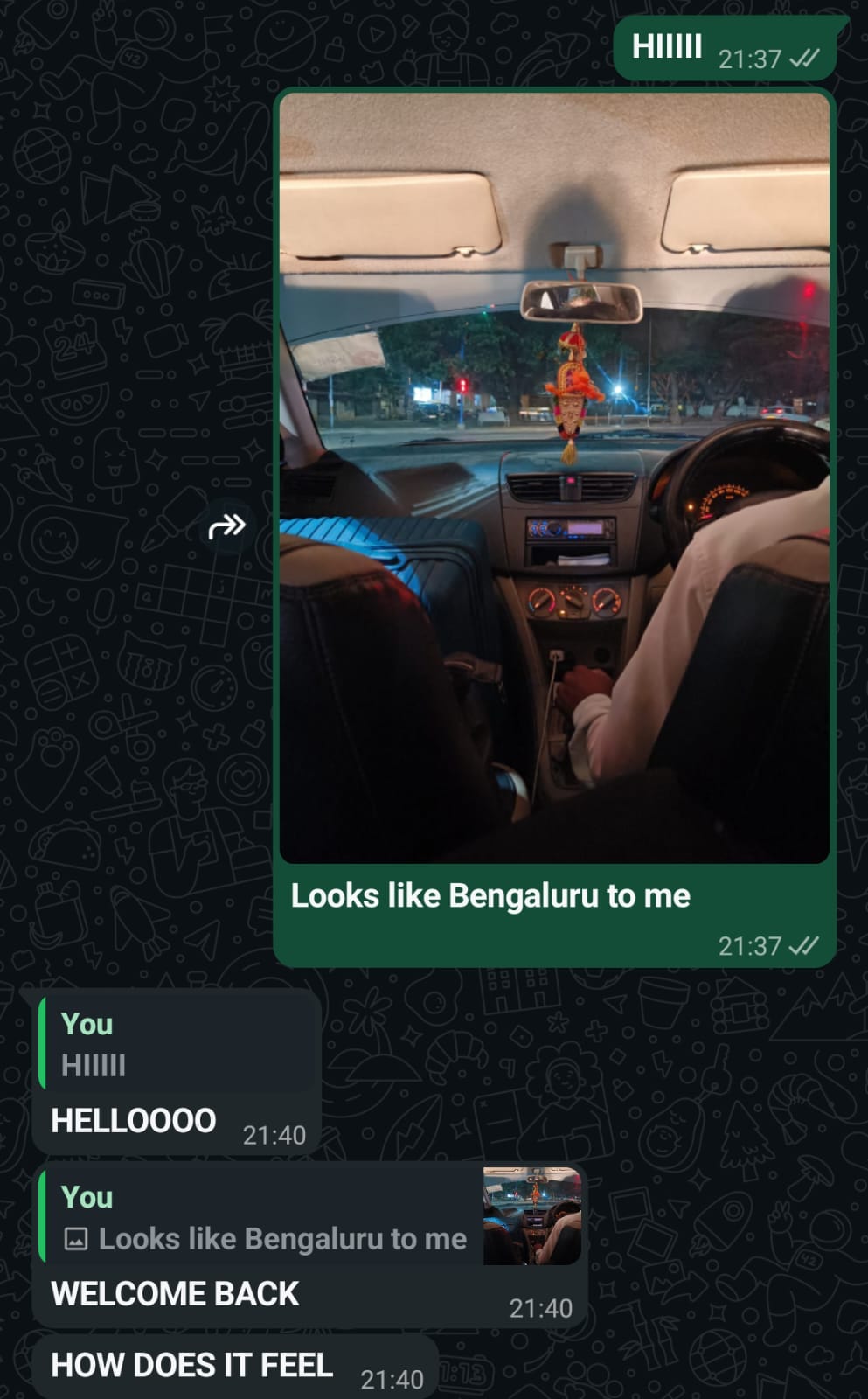
But when I came back, I embraced it. I romanticised the drive home even while being squeezed between two suitcases. The heat did not bother me, and I felt like I had been away for a very, very long time. The house opposite mine was being renovated, my neighbour’s grandchild was already a year old, and my mother had taken down all the posters from my wall.
But a lot more had changed — and a lot more had been lost — not just the posters. There were so many people I could not bring myself to reach out to after moving back because I had already lost them over the course of those few months spent six hours away from home. Conversations with friends felt distant. Catching up meant hearing about new people in their lives, things they had done months ago, and moments I would once have been a part of.
Now, I was just that friend who moved cities.
But no, it does not really stop there. I am the friend who is moving cities again, and this time, it is not just six hours away.
Before I began to write this, I looked up statistics on how many people are constantly on the move, and suddenly my own movement felt so small. There are people perpetually on the run, people who do not move out of choice or curiosity, but because staying back is no longer possible. People being displaced, migrating, fleeing, surviving.
And for the first time, movement began to feel like a vast spectrum to me. On one end, there is a 21-year-old like me who feels as though her entire life is being uprooted because she has to move across two cities within a year. But on the other end, there is a much bigger story of people for whom movement is not temporary discomfort or emotional upheaval, but an everyday reality.
But sitting at Becca’s apartment and realising that in three weeks I would be gone again, bags packed, and this time for a little longer than before, the shift felt far more significant than the last one.
I was now part of a young population constantly moving for work. I would be in another city, surviving the way so many people my age do. And apparently, this movement is becoming increasingly common.
A Forbes article I came across pointed out that nearly two-thirds of Gen Z workers are willing to relocate for work, driven not just by ambition, but by the search for opportunities, mentorship, stability, or simply a version of life that feels more sustainable. Now I do not know if I am going to live a life that is “sustainable”.
For a generation constantly associated with restlessness, burnout, and uncertainty, movement has almost become inevitable. Not necessarily toward prestige or permanence, but toward possibility. And somewhere within that larger shift was me too. Another 21-year-old packing up her life because an opportunity arrived and saying no to it felt impossible.
This time, it was not just a rebellious urge to leave home, nor was it some carefully calculated move. It was simply an offer that came my way, an opportunity that could finally place me inside the life and career I had spent years imagining for myself.
Jessica and Becca were excited. They wanted to know everything: the kind of work I would be doing, my work hours, the apartments I was looking at, the city I would soon begin calling home.
But a part of me was terrified of talking about any of it because I was not ready to move again.
I keep coming across posts online of text layered over aesthetic backgrounds which talk about how people are defined by the places they have been and the people they have met. That we become libraries of sorts, carrying stories, cities, and fragments of people within us. And while that sounds beautiful, I have always thought it was an incredibly romanticised way of looking at constant change — at all the winning and losing, the arrivals and departures, the people you meet and the people you slowly outgrow.
And as much as I want to become a collection of all the lives I have lived, the people I have met, and the lives still waiting for me, I cannot stop thinking about how there is always going to be more movement ahead.
Suddenly, stagnation feels comforting. The idea of staying back in the same room I have had since I was thirteen, a room my parents decorated for me, feels far more reassuring than the idea of building a space entirely on my own. The excitement of meeting new people has slowly stopped exciting me. I no longer want newness as much as I want familiarity. I want to be up to date with my friends and their lives, and for once, nobody else really interests me.
And this movement, even though it was not forced upon me, suddenly began to feel heavy too.
In three weeks, when I leave again, I am going to promise myself one thing, this time, I will stay awake when the train pulls out of the station. But that is all. I do not want to imagine a “last meal” at my parents’ dinner table or think too hard about the last time I see my friends before meeting them only annually.
As much as I dislike the way Instagram posts romanticise movement and change, I still want to become a collection of these last three weeks I spend in Bangalore, before I have to accommodate unfamiliar places, unfamiliar people, and a routine that, with time, will slowly become familiar too.
10/10 thumbnail
You occupy an entire aisle in the library of my brain.